


How AI can Change the Way you Think
Artificial intelligence is rapidly outgrowing its original role as a tool for speed and efficiency. In this thought-provoking piece, Mohammed AbdElhalim explores a more profound shift—one where AI becomes a collaborator in thinking itself. Drawing on compelling data and real-world adoption trends, he shows how AI is not just helping us do things faster, but helping us think differently: reframing problems, expanding possibilities, and sharpening decision-making.
From measurable productivity gains to a fundamental rewire of how individuals and organizations approach work, this article challenges readers to move beyond automation and into augmentation. It is a timely guide for anyone ready to treat AI not as a shortcut, but as a strategic partner in learning, creativity, and growth.
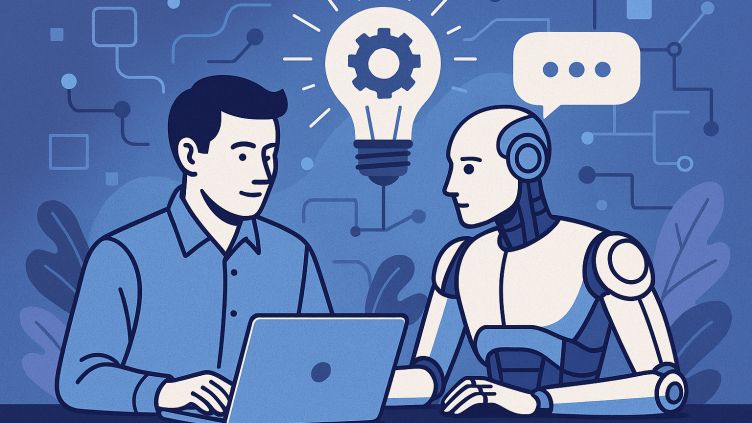
“AI is no longer just about efficiency gains – it’s changing how we think.
In this article, I explore how AI is evolving from a productivity tool into a true thinking partner that reshapes how we frame problems, explore ideas, and make decisions. Backed by recent research and market data, I highlight:
Hard numbers on impact:
1- A GPT-3–based assistant boosted customer support productivity by 14–15%, with the biggest gains for less-experienced agents.
2- GitHub Copilot users complete coding tasks up to 55% faster, and consultants using AI in trials delivered work ~25% faster with ~40% higher quality.
3- Nearly two-thirds of organizations are already using generative AI across multiple business units, and Gartner predicts 80%+ of enterprises will use GenAI APIs or apps by 2026, up from <5% in 2023.
4- 81% of IT leaders expect GenAI spend to grow, with global GenAI investment projected to reach hundreds of billions of dollars by 2025.
How AI changes your thinking:
– From answer seeking to hypothesis testing – using AI to generate options, then applying your judgment.
– From linear problem-solving to parallel exploration – testing multiple scenarios at once before deciding.
– From relying on memory to designing systems – building prompts, workflows, and a “second brain.”
– From solo effort to human–AI collaboration – letting AI handle pattern recognition while you focus on context, ethics, and relationships.
Top 3 takeaways for any AI journey:
– Treat AI as a junior partner, not an oracle – keep humans in the loop and always verify.
– Invest in prompting and evaluation – your ability to ask, refine, and judge will be the real differentiator.
– Design your AI use around ethics, learning, and long-term value – use AI to learn faster and challenge your assumptions, not to switch off your thinking.
Bottom line: If you use AI only to automate tasks, you’ll get incremental gains. If you use it as a thinking partner, you can fundamentally upgrade how you learn, decide, and create.
If you’re curious about how to structure your own AI journey – or how to bring your team along – this article is for you.
© Mohammed AbdElHalim 2026
Numeris Media is Media Partner to AI EVERYTHING KENYA (Nairobi) x GITEX Kenya 2026 – Africa’s biggest AI Summit