

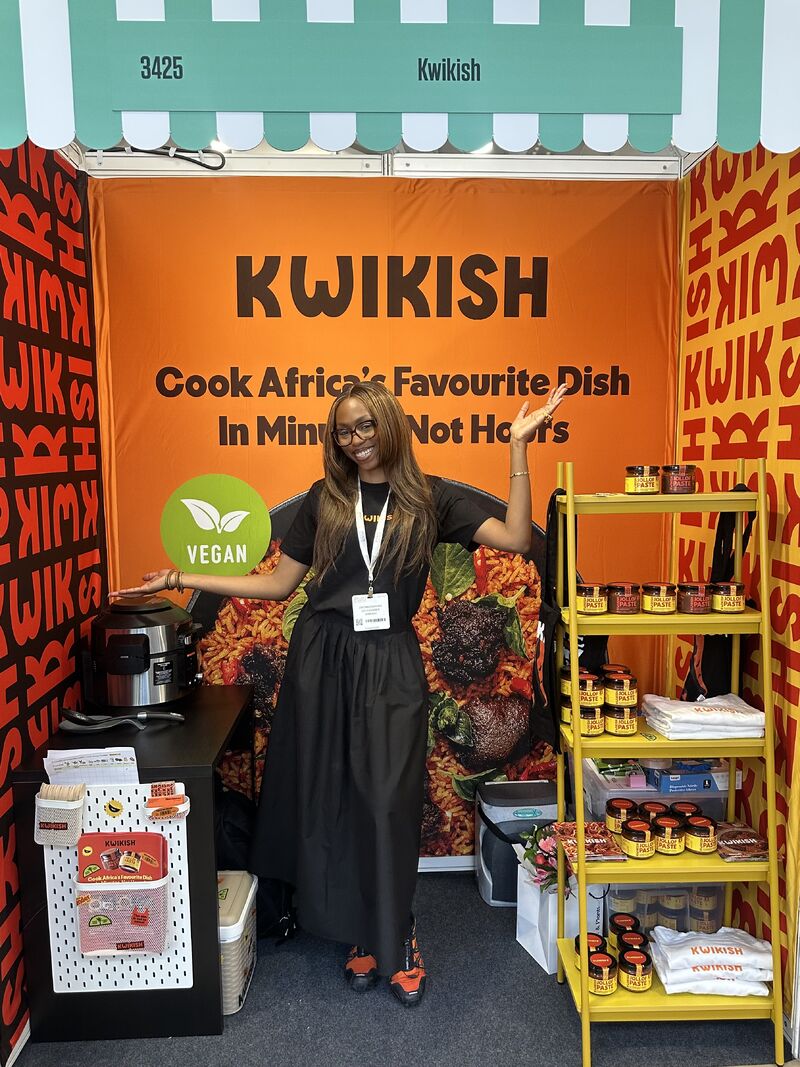
A familiar craving
It started with a familiar feeling—one that many Africans in the diaspora know too well.
A long day. A craving for something real. Something that tastes like home.
For Adeoluwa Fola-Alade and Zikora Enweani (Founders of Kwikish), that craving often pointed to one thing: proper West African food. Not shortcuts. Not watered-down versions. The real thing—rich, layered, deeply satisfying.
The time problem
But there was a problem.
Real African cooking takes time.
The kind of time that modern life rarely gives. Between work, commuting, and everything else that comes with living in a fast-paced city like London, cooking a pot of jollof the traditional way could feel like a luxury reserved for weekends—or special occasions.
The convenience vs culture dilemma
So like many others, they faced a quiet dilemma:
Choose convenience… or choose culture.
They refused to accept that those two had to be opposites.
Instead, they asked a different question:
What if you could have both?
What if the depth of African cooking—the flavors, the aromas, the identity—could be preserved… but the process simplified?
That question became an idea.
And that idea became Kwikish.
Unlocking the African kitchen
Kwikish wasn’t built to replace traditional cooking. It was built to unlock it.
They began rethinking the African kitchen—not by removing its essence, but by redesigning its entry point. Hours of prep became minutes. Complex layers were carefully captured into ready-made bases. The goal wasn’t to cut corners—it was to engineer convenience without losing authenticity.
More than a product
A jar of jollof paste wasn’t just a product.
It was time saved.
It was culture preserved.
It was access—on demand.
But something deeper was happening beneath the surface.
Kwikish was speaking to a generation of Africans who were navigating two worlds at once—deeply rooted in where they come from, yet fully immersed in a global, fast-moving lifestyle. People who didn’t want to lose their food, their flavors, or their identity… but needed it to fit into their reality.
From food to belonging, from access to ambition
And in solving that, Kwikish tapped into something powerful:
Not just food…
but belonging.
From that point on, the vision grew.
Because once you solve the problem of access, the next question becomes:
How far can this go?
And the answer is—very far. Kwikish isn’t just building products. It’s building a platform for African cuisine at scale.
Scaling through distribution
First, through distribution—placing African flavors where global consumers already shop. From specialty African stores to mainstream supermarket shelves, the goal is simple: make Kwikish as easy to find as any global food brand.
Redefining retail positioning
Then, retail expansion—positioning African food not as “ethnic,” but as everyday. The same way pasta sauces and curry pastes sit comfortably in aisles around the world, Kwikish can claim its space—normalizing African cuisine in global households.
Owning the customer relationship (DTC)
Alongside that sits direct-to-consumer (DTC)—a digital bridge between the brand and its community. Through its own platform, Kwikish can educate, tell stories, share recipes, and build loyalty beyond the shelf. Not just selling products, but curating an experience—one that brings people deeper into African food culture.
The power of partnerships
And then, the multiplier: partnerships.
Collaborations with:
- Food retailers
- Restaurants and cloud kitchens
- Influencers and chefs
- Even global food platforms
Each partnership extends reach, embeds the brand into new ecosystems, and accelerates cultural adoption.
Beyond products: owning a category and leading a global food shift
Because the real opportunity isn’t just selling jars.
It’s owning a category.
Kwikish sits at the intersection of convenience and culture—a space that global markets are already primed for. And with the right execution, it can evolve from a product company into a category-defining African food powerhouse.
One that doesn’t just follow global food trends, but helps shape them.
Because if Italian, Thai, and Indian cuisines have found their fast, global formats—
then African cuisine is not next.
It’s overdue.
A new era for African cuisine
And Kwikish is positioning itself to lead that moment.
Bridging tradition and modernity.
Connecting heritage with hustle.
Scaling flavor across borders.
And in doing so, feeding not just appetite—
but a global shift in how African culture is experienced, embraced, and enjoyed.
Numeris Media is media partner to GITEX Africa 2026 – Africa’s largest tech and startup show